Ridgewood School
Post 18 Options: University
Here at Ridgewood School, we’re committed to helping every sixth former take confident steps towards life beyond Sixth Form. Whether your next chapter involves university, an apprenticeship, or entering the world of work, we ensure you’re equipped with the knowledge, skills, and support to make informed choices. Through expert guidance, dedicated advice, and opportunities to explore different pathways, Ridgewood prepares you for success—whatever your ambitions may be.
A full programme will be delivered during PDP and assembly from your dedicated 6th form team and carefully selected alumni and expert visiting speakers.
If university is a route you are considering, the links below will help you prepare for the road ahead:
UCAS Useful Links: |
Other Useful Links: |
|
|
|
|
|
|
|
|
|
|
|
|
|
|
|
FAQs
Can I use AI to help me write my applications? No! This is not advised. This is about you! Your Interests, your knowledge, your experiences, what makes you stand out. If AI is suspected to have been used your application will not be considered.
I don’t want to go to University, should I still write a personal statement? Yes. The process for applying for an apprenticeship is very similar, so having the personal statement ready for your area of interest in industry, with the help and guidance of your teachers, will be advantageous for you.
Can I apply to Uni after the ‘equal consideration’ deadline? –Yes. But you will not be given ‘equal consideration’ unlike your peers who met this deadline.
Can Universities offer places as soon as I have applied? Yes! Some make offers within days of receiving an application, others take longer.
I want to put off university for another year, what shall I do? Apply this year, so you can access all the support from school. On results day, when you have your offer, you can choose to ‘defer’ you place - the university can hold your place for one year. This is called a deferred entry.
Can I apply to university without using UCAS? No. All UK universities use the UCAS platform.
Is there a fee for applying to university? Yes, a fee of £28.95 is currently charged to apply. However, if this is the reason you feel unable to apply please speak to a member of staff. All bursary students can have this fee paid by the school.
Can I apply for university and an apprenticeship? Yes. You can apply for both in order to keep your options open.
Can I get financial help? Yes. The student loans company is specifically set up to help students pay for tuition and everyday living costs (tuition fee loans and maintenance loans). There are also a variety of schemes which may be available due to your circumstanced and/or your academic excellence.
What if I don’t get the grades needed to get into my firm or insurance choice university? There is an option on results day to go through clearing. This is where universities advertise courses they haven’t yet filled. If you meet their entry requirements you may be accepted onto their course.
What if I get higher grades than needed to get into my firm or insurance choice university and want to consider a more prestigious university? There is an option on results day to go through clearing. This is where universities advertise courses they haven’t yet filled. If you meet their entry requirements you may be accepted onto their course.
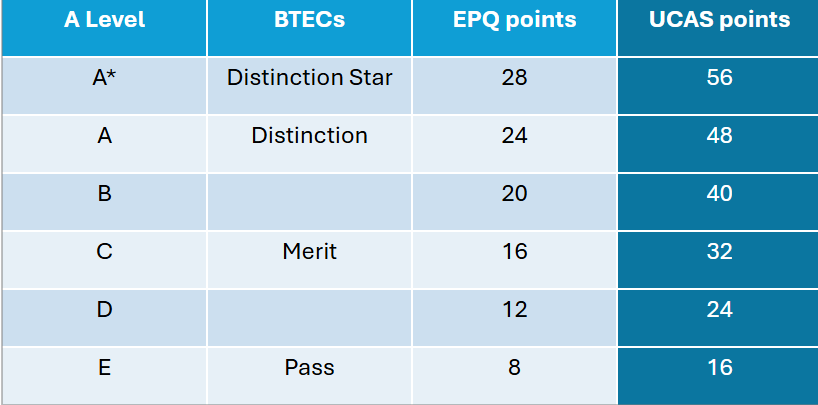
What are UCAS points and how do I calculate them? See the information table under Jargon Buster (along with many frequently used terms) that follows, this clearly sets out all UCAS tariffs.
Jargon Buster P18
Understanding the Jargon surrounding Post 18 study in the UK:
As students prepare, it's essential to become familiar with the terminology and shorthand commonly used in the UK education system. This jargon buster will help to navigate the application process, understand different types of courses, and comprehend finance options.
Levels of study - The UK educational qualification system ranges from level 1 to 8. Students at 6th Form are studying Level 3 qualifications (e.g. A Levels, BTECs, Diplomas and T-Levels). Degree-level courses start at level 4. Completing an undergraduate degree gains you a level 6 qualification, while postgraduate degrees are level 7, and doctorates are level 8. Apprenticeships work in the same way; form Level 2 all the way up to Level 6 and 7. Achieving a level 6, degree apprenticeships will see you graduate with your cap and gown moment and gain exactly the same qualification level as a university student completing their degree.
Level 3 course grades – Although GCSE students are graded from 1-9 (9 being the highest achievable grade), A Level students are graded from and E-A* (A* being the highest achievable grade) and in BTEC courses are Graded Pass, Merit, Distinction or Distinction*(Distinction* being the highest achievable grade).
UCAS - The Universities and Colleges Admissions Service (UCAS) is the organisation that manages applications to higher education courses in the UK. When applying to university, you will use the UCAS system to submit your application, which includes your personal statement and details of your qualifications. There is a small administration fee to apply.
UCAS points. - Each grade you receive in your level 3 courses equates to UCAS points. When you receive an offer from a university, they may ask that you gain x number of UCAS point from your subjects (alternatively, they may stipulate specific grades you need to achieve)
UCAS points are calculated as seen below:
Degree - A degree is an academic qualification awarded by a university upon completion of a program of study. Common types of degrees include bachelor's, master's, and doctoral degrees. In the UK, there are several types of degrees across different educational levels:
Foundation Course - A foundation course is a program designed to help students bridge the gap between school and university. These courses often focus on enhancing skills in specific subjects and preparing students for undergraduate study. They are typically 1 year in length.
Undergraduate - An undergraduate is a student who is pursuing a bachelor's degree. This is the first level of higher education, typically lasting three to four years. E.g. Bachelor of Arts (BA), Bachelor of Science (BSc), Bachelor of Education (BEd), Bachelor of Engineering (BEng), Bachelor of Laws (LLB), Bachelor of Medicine, Bachelor of Surgery (MB ChB) etc
Postgraduate - A postgraduate student is someone who has already completed a bachelor's degree and is now pursuing advanced study,
Master's degree including Master of Arts (MA), Master of Science (MSc), Master of Research (MRes), Master of Philosophy (MPhil), Master of Business Administration (MBA), Master of Laws (LLM)
PhD - Doctor of Philosophy (PhD) is the highest academic degree one can achieve. A PhD involves conducting original research and contributing new knowledge to a specific field.
Conservatoire - A conservatoire is a specialised higher education institution focused on music and the performing arts. Students receive training in their chosen artistic discipline.
Russel Group Universities The Russell Group's 24 members are world-class, research-intensive universities. They are unique institutions, each with their own history and ethos. Oxford and Cambridge are part of this as well as other universities. E.g. University of Sheffield, University of York, University of Southampton, Durham University etc. These are the most prestigious universities in the UK and therefore the most competitive.
Oxbridge the term used for Oxford and Cambridge universities together. These institutions often require students to take specific entry tests and achieve the highest grades possible.
Early Entry Students – Students wishing to apply for Oxford and Cambridge, or students applying for Medicine, Dentistry or Veterinary courses will apply earlier than other students in the cohort, with the deadline in the October of Year 13.
Admissions Tests and UCAT – For some courses and universities you are required to pass an Admissions Test. Commonly, UK University Tests are for students who are looking to study medicine, dentistry, veterinary or entry to Oxford and Cambridge. These include UCAT, LNAT, ESAT, MAT, BMAT, PAT. Please ask a member of staff for further information.
Student Finance - Student finance refers to the financial support available to help students cover the cost of their higher education. This includes tuition fees and living expenses.
Loan Tuition - Loan tuition refers to the amount of money borrowed to pay for university tuition fees. Students typically repay this loan after they graduate and start earning above a certain income threshold.
Maintenance Loans - A maintenance loan is a type of financial aid that helps cover living costs while studying. The amount you can borrow depends on your household income and where you study.
Scholarships and Bursaries - Scholarships are financial awards given to students based on academic achievement, talent, or other criteria.
Bursaries are grants offered to students based on financial need to help cover tuition or living expenses. These are not loans and are therefore non repayable.
Halls of Residence - Halls of residence are accommodations provided by universities for students. Living in halls can offer a supportive community and is often a great way to meet new people.
Campus - A campus is the physical area where a university is located, including buildings, facilities, and outdoor spaces. It is the hub of university life.
Deferring - A deferred entry means applying for a course and then taking a year out before starting it – after you successfully accept your offer the university will hold the place for you for a year.
Placement Years - A placement year is an opportunity for students to gain practical experience in their field of study, included in some degree programs. This year typically takes place between the second and final years of study.
Sandwich Years – Sandwich years are similar to placement years but involve alternating periods of study and work experience, giving students more exposure to their field.
Joint Honours - Joint honours degrees allow students to study two subjects simultaneously, providing a broader educational experience and skill set.
Open Days - Open days are events hosted by universities to allow prospective students to explore the campus, meet the faculty, and learn more about their programs. These can sometimes take place virtually if required.
Conditional Offers - A conditional offer is an invitation to study at a university, contingent upon meeting specific requirements, such as achieving a certain grade in your exams.
Unconditional Offers - An unconditional offer means you have been accepted to a university without any conditions; you have met or exceeded the entry requirements.
Contextual Offers - Contextual offers take into account the applicant's background and circumstances, allowing for a more flexible approach to meeting entry requirements.
Firm Choice – From the universities/colleges that have offered you a place, you will have to decide which is your preferred place and identify this as you ‘firm choice’
Insurance Choice - From the universities/colleges that have offered you a place, you will have to decide which is your second-choice place, this is usually a lower offer, allowing you some security in case you don't meet the requirements of your firm choice.
Clearing - Clearing is a process that helps students find available university places if they did not secure a spot during the main application cycle, if they did not meet the requirements of their offers or if they exceeded their expectations and wish to apply for a more prestigious university. This typically occurs after A-level results are released, and only where places are still available on specific courses.
UCAS extra – if you have not received an offer from any of your 5 university placements, UCAS extra allows you to add an extra sixth choice to your UCAS application.
Outreach Programmes - Outreach programmes are initiatives aimed at encouraging and supporting students from under represented backgrounds to consider higher education, these typically include students from low-income families, are care experienced, have a physical or learning disability, are from ethnic minority background or other criteria chosen by the individual university.
Freshers week – is a welcoming week or orientation week at university usually at the end of September. It is a period at the start of the academic year where new students are welcomed to university life with a variety of events, parties, and networking opportunities. It's designed to help students settle into their new environment, meet classmates, and explore the university and city before your lectures begin.
Higher Apprenticeships - Higher apprenticeships combine work and study, allowing students to earn a salary while gaining practical experience and working towards a higher education qualification.
Degree Apprenticeships - A degree apprenticeship is a particular type of job, which combines work with higher-level learning, and which leads to an undergraduate or postgraduate degree. Apprentices spend most of their week at work. But they also spend at least 20 per cent of their time in off-the-job study or training. A university will support the degree, but the employer will pay for the full cost of the degree course.
CV - or a Curriculum Vitae is a summary of your skills, achievements and experience that you use to apply for jobs. Much like a personal statement for university
Cover Letter – Often this accompanies a CV. Its states your interest in position advertised, why you see this as the right position/company for you, why you are right for the position and where it might fit into your future plans.