
Ridgewood School
Post 18 Options: Apprenticeships
Here at Ridgewood School, we’re committed to helping every sixth former take confident steps towards life beyond Sixth Form. Whether your next chapter involves university, an apprenticeship, or entering the world of work, we ensure you’re equipped with the knowledge, skills, and support to make informed choices. Through expert guidance, dedicated advice, and opportunities to explore different pathways, Ridgewood prepares you for success—whatever your ambitions may be. A full programme will be delivered during PDP and assembly from your dedicated 6th form team and carefully selected alumni and expert visiting speakers.
If apprenticeships are a route you are considering, below are some useful links which will help you navigate some of the information to prepare for the road ahead.
Useful Information: |
Specific Company Website: |
|
|
|
|
|
|
|
|
|
|
|
|
Jargon buster Post 18 Apprenticeships
Understanding the Jargon surrounding Post 18 study in the UK
As students prepare, it's essential to become familiar with the terminology and shorthand commonly used in the UK education system. This jargon buster will help to navigate the application process.
Levels of study - The UK educational qualification system ranges from level 1 to 8. Students at 6th Form are studying Level 3 qualifications (e.g. A Levels, BTECs, and Diplomas). Degree-level courses start at level 4. Completing an undergraduate degree gains you a level 6 qualification, while postgraduate degrees are level 7, and doctorates are level 8. Apprenticeships work in the same way; from Level 2 all the way up to Level 6 and 7. Achieving a level 6 degree apprenticeships will see you graduate with your cap and gown moment and gain exactly the same qualification level as a university student completing their degree.
Level 3 course grades – Although GCSE students are graded from 1-9 (9 being the highest achievable grade), A Level students are graded from and E-A* (A* being the highest achievable grade) and in BTEC courses are Graded Pass, Merit, Distinction or Distinction*(Distinction* being the highest achievable grade).
UCAS - The Universities and Colleges Admissions Service (UCAS) is the organisation that manages applications to higher education courses in the UK. When applying to university, you will use the UCAS system to submit your application, which includes your personal statement and details of your qualifications. There is a small administration fee to apply.
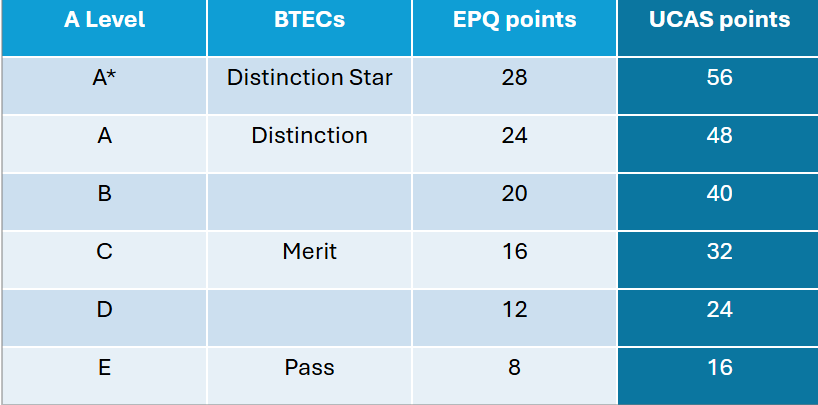
UCAS points. - Each grade you receive in your level 3 courses equates to UCAS points. When you receive an offer from a university or an apprenticeships provider, they may ask that you gain x number of UCAS point from your subjects (alternatively, they may stipulate specific grades you need to achieve)
UCAS points are calculated as seen below:
Degree - A degree is an academic qualification awarded by a university upon completion of a program of study. Common types of degrees include bachelor's, master's, and doctoral degrees. In the UK, there are several types of degrees across different educational levels:
Higher Apprenticeships - Higher apprenticeships combine work and study, allowing students to earn a salary while gaining practical experience and working towards a higher education qualification.
Degree Apprenticeships - A degree apprenticeship is a particular type of job, which combines work with higher-level (level 6 or 7) learning, which leads to an undergraduate or postgraduate degree. Apprentices spend most of their week at work. But they also spend at least 20 per cent of their time in off-the-job study or training. A university will support the degree, but the employer will pay for the full cost of the degree course.
CV - or a Curriculum Vitae is a summary of your skills, achievements and experience that you use to apply for jobs, much like a personal statement for university.
Cover Letter – Often this accompanies a CV. Its states your interest in position advertised, why you see this as the right position/company for you, why you are right for the position and where it might fit into your future plans.